
Audio/video version available on YouTube:
To cooperate, or not to cooperate
A lot of conflict between couples comes down to a perpetual decision that they’re trying to make: how much should the two people cooperate toward shared goals, and how much should they “do their own thing” and pursue separate goals? We could call this the cooperation question.
On the surface, the conflict often looks more malignant — something like selfishness, stubbornness, sabotage, a defensive refusal to listen or to be honest — basically some form of badness or madness. Unmasking the cooperation question can make it less threatening and thus more answerable — no one’s bad or mad, we’re just indecisive as a unit, even if as individuals, we very much know what we want.
There’s a metaphor from game theory called “the stag hunt” which I think can give an anxiety-reducing view of the root cause of many — sometimes most — of a couple’s arguments. The Stag Hunt is a metaphor for understanding why shared goals can be so elusive, and why communication can abruptly end or go sideways. It’s a social pattern — sometimes called a “game” — about the benefits of mutual cooperation, and the danger of unrequited cooperation.
Picture two people in the same forest, both hungry. One is tracking a rabbit, the other is watching a stag. But neither of them made their full plans — or the help they need — known to the other. One thinks they’re cooperating, the other thinks they’re hunting independently. So they spend the whole day crossing each other’s paths, spooking all the game, and waiting for help they expected but that was never known to the other. They didn’t cooperate to hunt the same large animal, or even consciously decide that they’d each do this hunt solo. False assumptions were made and mindreading failed, and the only thing they caught that day was a case of mutual disappointment and frustration.
While the activities and outcomes are different, this is essentially the same social, transactional pattern that brings many couples to therapy.
The stag hunt involves a few simple assumptions:
- It’s impossible to catch a stag by yourself, but doable with help if you work together and collaborate.
- Catching a rabbit is achievable by yourself.
- And catching a stag together is much better than catching a rabbit on your own, since a stag is an order of magnitude bigger.
The incentives of the stag hunt are clear: if you’re on your own, you should aim for the small goal of catching a rabbit so that you can get something — albeit small — to eat. But if you have a solid relationship with someone you can depend on, and a shared goal, then you can put your skills, resources, and efforts together, and go for something much bigger than you could each get on your own — the big prize of the stag.
Crosshairs and cross-purposes
Much of the time when couples are arguing, they’re arguing about what they’re doing. What is their shared goal? What are they “hunting for”? What are they trying to accomplish?
For example, think of arguments regarding money. One wants to spend on things now and the other wants to save for something else later, or simply have it for security — for the unknown and unpredictable expenses. In other words, they’re shooting at different targets — working at cross-purposes. The “relationship foot” is on the gas and brake pedals at the same time. One side spends the money and the other loses their sense of security; or one side hoards money for security and the other misses out on the experiences they long for, that money could have bought.
The four classic outcomes
In the traditional stag hunt from game theory, there are four outcomes:
- Both hunt the same stag (and both receive a large payoff)
- One tries to hunt the stag and the other a rabbit, or …
- the other way around (in either case one gets a small payoff and the other gets nothing)
- Both try to catch a rabbit (and both get a small payoff)
This is what the four outcomes look like in a 2×2 matrix:
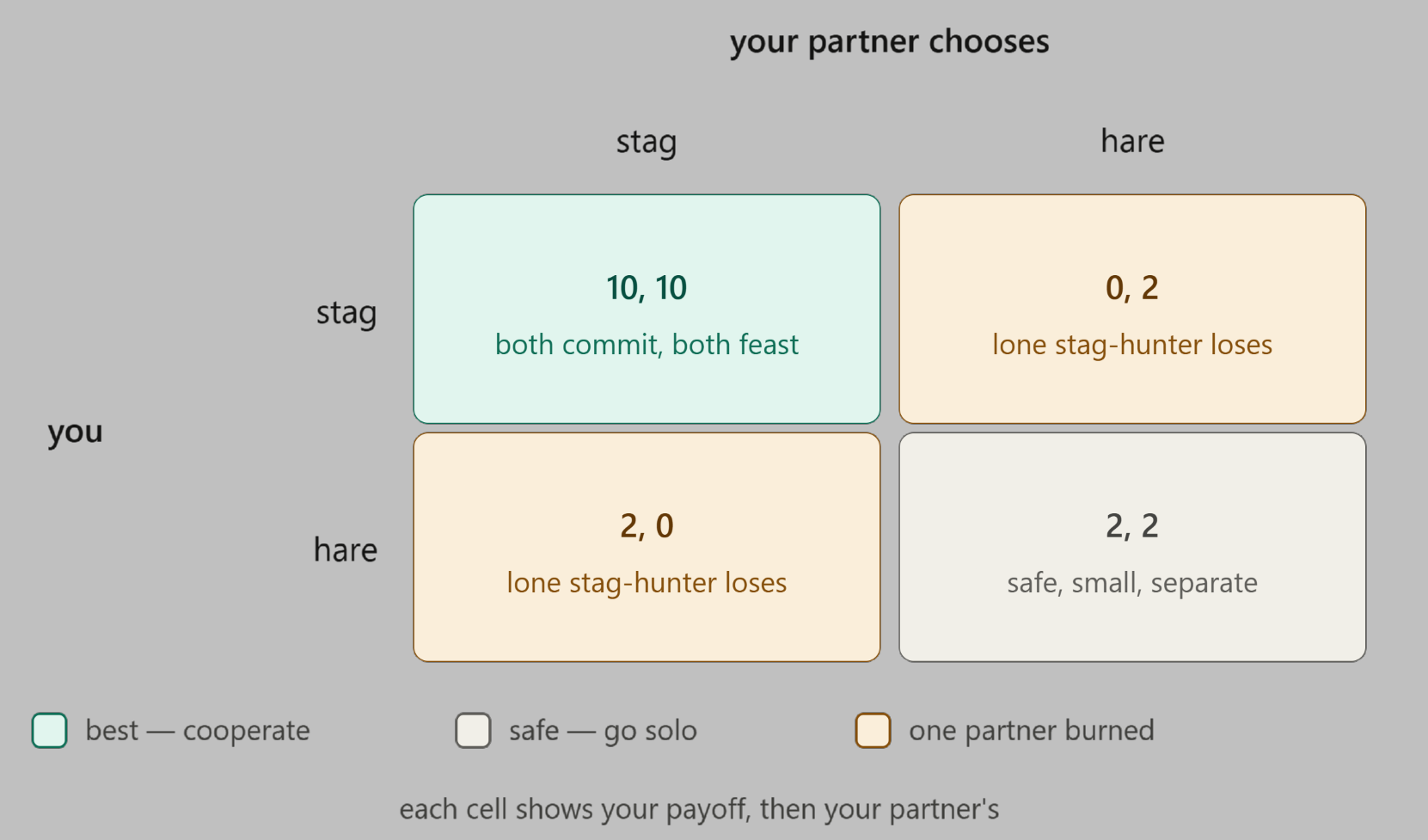
Here, the numbers 10, 2, and 0 represent a big payoff, a small payoff, and no payoff.
Here’s an example for each outcome, applied to intimate couples:
Outcome 1: Both hunt the same stag. When partners commit to the same stag, they pull off something neither could manage alone. Imagine a couple who wants to buy a house. At first they’re not aligned — one pictures a small place paid off free and clear, the other a bigger house in the right school district with a thirty-year mortgage. But they keep talking, and instead of fighting after every open house, they find the overlap: a modest home in a decent district with a practical-enough monthly payment, bought together. Neither could have done it alone, on their own income or their own nerve. That cooperation led to their stag — the achieved large goal that the partnership made possible. A successful stag hunt is an example of synergy where the whole is greater than the sum of its parts. One plus one is not equal to two, but might equal ten in terms of results.
Outcome 2 and 3: One hunts the stag, the other a rabbit. Here, let’s say the game both are interested in is interpersonal connection. But one partner keeps reaching for deep, one-on-one bonding — presence, eye contact, shared secrets and stories, and heart-to-heart resonance. They keep setting up the hunt. But the other partner drifts off, not ready to get that close. They go for smaller, solo catches — watching TV in parallel, phone scrolling through parasocial relationships, and making small talk with the restaurant server. This partner doesn’t want to go for the big goal of the stag. That isn’t necessarily wrong, but they are not on the same hunt. The one stalking the stag comes home empty-handed, while the other one subsists on their rabbit of shallower but safe connection.
Outcome 4: Both settle for rabbits. Sometimes both partners give up on the big shared goal. Consider a couple’s social life: he has his poker night and she has her book club, and they’ve stopped doing social things together. So each hunts a small, reliable rabbit alone. Nobody’s miserable, but they do get less time together because they can’t agree on a satisfying way to interface with the rest of the society together. Sometimes it’s just fine to be in a relationship and hunt rabbits separately; more on that later. But sometimes it means they’re not ideal hunting partners.
Three ways to catch nothing
There are more than four outcomes in the real, messy, and nuanced world of love and relationship. As a couples therapist I’ve noted three other outcomes, in addition to the standard four, and — they get progressively worse.
Outcome 5: The hollow catch. This hunt looks like a win-win initially and from the outside — the couple agrees, they go after the same stag, and they catch it. But one partner never really wanted it, and they gave in to avoid the hard conversations about their conflicting needs. Take a couple deciding whether to move closer to one partner’s aging parents. One wants to go; and the other would rather stay near their own career and friends and not be uprooted, but doesn’t feel they have standing to say no to family duty — so they agree, and move.
For a while it looks like a 10, 10 on the matrix: same stag, hunt successful. But the meat slowly rotted, especially for one of them. The partner who capitulated wasn’t actually at a 10 the day they agreed — call it a 7, since going along under pressure — or due to conflict avoidance — isn’t the same as wanting it. And that number keeps dropping, as they watch their new location harden into their actual life, and resentment compounds. Meanwhile, the partner who genuinely wanted the stag doesn’t necessarily stay at 10, because watching someone they love grow increasingly unhappy costs them something too, as their 10 erodes to a 5.
Outcome 6: Hunting different stags. Here, both partners think that they’re hunting the same stag, but they’re actually working toward different large goals, and so they don’t cooperate and both catch nothing. Say that they both think they’re after the stag of “taking more vacations together”, only they have different thought bubbles over their heads. One of them imagines sipping margaritas at the Mandalay Bay in Vegas, chatting up strangers in a crowded pool. The other one wants to go to a hippie Buddhist retreat with vegetarian food and lots of chanting mantras and silent walking. Let’s say they do one of each, and in both experiences, one of them is miserable, and so the other one doesn’t really have a good time either. There were two different stags and both got away. But in this case they both thought they were on the same hunt until they spotted their stag and realized the other was nowhere to be found.
Outcome 7: The hunt never happens at all. This outcome is when most of the couple’s time is spent arguing about which stag to hunt. Take a couple who can’t stop fighting about the family purpose and structure: one wants the parent-child bond to be the centerpiece of the family, the other wants the couple’s relationship to be the foundation, with the kids coming second to the marriage, and learning to support each other as siblings. Neither partner budges and the fundamental disagreement never resolves. It manifests at every bedtime and every discipline decision, until each is convinced the other is simply in the wrong when it comes to what family should really mean.
Not agreeing on the hunt could be a consequence of emotional wounding and defenses that result in reactive and destructive communication. But it could also simply be a symptom of innate incompatiability. In my 3-part video series called “Three Pillars Of A Nourishing Relationship”, I talk at length about how to know the difference between these root causes of an inability to cooperate.
This outcome, the worst of all, is anti-synergy — the situation where 1+1 yields a negative number, like minus 1 or minus 5. Sometimes, if the fights are destructive enough, the sum could be minus 100. There is virtually no limit to the downside in conflict. Instead of catching a rabbit or stag or even doing nothing, all their energy goes into tearing each other down with blame and shame – basically meta-communicating to each other, “you’re a bad partner because you don’t help me get what I want.” This is an escalating negative cycle in which both partners feel attacked, accused, shamed, unworthy, and generally beaten-down. They share the same incorrect diagnosis of their problem — that one of them is the bad guy, the defective one, the villain. But the real, simple issue is that they just don’t agree on a shared goal.
Stags and rabbits
In all of the previous examples, there was nothing morally or inherently wrong with what any of the partners wanted. They were just preferences. Having conversations about where to invest your shared, limited energy is very challenging because you both want what you want. And while I have my preferences and you have yours, it’s not very productive to judge how someone else wants to spend their life, especially your partner, if you think about it. The question is, can you find enough shared goals and pursuits so that you can share time, space, and connection happily enough?
Or, as Hamlet might have said:
To cooperate, or not to cooperate — that is the question:
Whether ’tis nobler in the wood to bear
The safe scraps and hunger of the meager rabbit,
Or to take arms against a herd of stags,
And by collaborating, catch one.
A relationship doesn’t fail because partners have some different goals. It fails when there’s not enough shared goals, or sometimes when a “non-negotiable” life goal is not shared. For some people, “non-negotiable” stag hunts could include the mutually exclusive goals of having kids vs remaining child free, or living in a dense urban area vs a remote rural one.
The stag hunt is simply a metaphor, and it could apply to the entire relationship — the big stag hunt in this case is being together successfully, and the separate rabbit hunts represent breaking up and being single again. In the one big stag hunt of the relationship, successfully catching the stag is something like “consistently enjoying intimacy”, or “shared happiness”, or simply “love”.
But more often I apply the stag hunt metaphor to specific goals within a couple’s relationship — especially when goals are unclear, incorrectly intuited, and not fully discussed or known to each other.
It’s okay for couples to sometimes hunt a stag together and sometimes hunt rabbits separately, as long as there’s enough shared hunting to make the relationship make sense. They can have separate hobbies and do different activities, keep separate bank accounts, I think even practice different religions or parent their kids somewhat differently, if they’re both able to accept and respect each other’s ways of being in the world.
But it’s not avoidance that will lead to sound hunting plans together or separately. It’s thorough, curious, open-minded, and sometimes courageous communication.
Every rabbit hunter for himself/herself
When one or both partners gives up and shuts down the conversation – and this can happen in many different ways – it essentially communicates: “We are not going to agree on a stag to hunt together. This group, collaborative hunt thing is just not going to work. I’m going to hunt my game and you can either help me or not, but I’m done planning hunts with you.”
To be clear, shutting down communication isn’t always walking away. It can also look like unproductive battling — staying in contact but being overly dominant, controlling, and dismissive of the other person’s perspective — a “my way or the highway” attitude that’s disguised as “trying to communicate”.
Either way, the shift to communication breakdown generally causes both people to withdraw and retreat into their own separate goals and agendas. They each go off and hunt small game like rabbits alone, which is quite sad when you’re in a relationship. What’s the relationship for if both partners are — unnecessarily and too frequently — limited to their own individual capacities?
The tragedy is that both people are being rational in this situation; it doesn’t make sense to try to hunt a stag with someone who’s hunting a different animal, because you’re not going to catch anything on your own, the stag is just too fast and big. You’re better off just hunting like a single person.
Usually, in my experience, if a couple has been together for a long time, they can agree on enough shared goals. But the uncomfortable uncertainty of thoroughly discussing those yet-undefined goals causes them to walk away from hurt and frustration before they’ve understood each other. So they miss many opportunities for mutually acceptable stag hunts, because the work to reach that agreement is painful and unsettling.
Hunting for decisiveness
So what do I think couples should do when they’ve given up on (productively and non-reactively) talking about what they’re hunting?
The short version of the answer is remarkably similar to my answer to most relational and emotional problems. And that answer is to stay with it even though it’s uncomfortable.
Bailing out of communication with your partner — or dominating and pushing for control out of anxiety — before genuine agreement is reached — or you agree that separate hunts are in order — is an example of what I call experiential avoidance. It’s an eject button from our emotions. It’s essentially saying, “these feelings are too hard due to this conversation and I don’t want to feel them, so I’m going to escape from them by ending the dialogue or just not being open to you.”
Good solutions are downstream from understanding
The first crucial step is to recognize that the urge to give up, or overpower the other, is an attempt to regulate your nervous system which has become dysregulated by the discomfort of uncertainty, the ambiguity of not yet having a solution, and the deeper subconscious fear that the solution for this hunt is to hunt rabbits alone (which it might in fact be). And again, more rabbit hunting separately might be a deal-breaker, but it might simply mean that you stay together happily enough, but agree to operate more independently in certain areas of life.
Win-win or no deal
The stag hunt and its outcomes map on to the 4th of Stephen Covey’s “7 habits of highly effective people”. Unifying and agreeing on a stag to hunt together is what Covey would have called a “win win”. He cautioned against going for a “lose win” or a “win lose”, for example when one partner capitulates and just hunts the game the other wants, but then feels resentful later. Since “win win” is not always possible, the way to avoid “lose win” or “win lose” is to go for a “no deal”. A “no deal” in this case is to hunt smaller game separately, when the large game can’t be agreed on. He stays home while she travels, for example, rather than him going or her staying and one of them feeling deprived.
The worst outcome is “lose-lose”, and earlier I described two variations of lose-lose in the stag hunt pattern: 1) endlessly arguing about what to hunt, or 2) hunting different stags and catching nothing.
There’s a good case that in couples relationships, every “win lose” or “lose win” eventually becomes a “lose lose” over time, because when one partner loses due to the relationship, it erodes their mutual bond. This is, in effect, a lose for the one who initially seems to win, because now the “winner’s” secure attachment is compromised.
That’s solid motivation for avoiding any outcome in which either partner loses, which is why the option of “no deal” is absolutely crucial to be aware of.
When we’re kids, “no deal” isn’t generally an option, because we depend on our parents and family for survival, so we often grow up with a template that we should in fact try to “win” even if it means someone else loses, when we can’t see or find a “win win”. And as the less powerful family members, children often end up being the ones who lose in transactions, which normalizes the core belief that “in families someone needs to lose, and I should try to not be that person”. This core belief underlies a lot of subconscious dishonestly, deception, and manipulation that can happen in dysfunctional relationships and families. Since “no deal” is simply not in anyone’s wheelhouse, the family can sadly become a mutually strategic arena in which everyone tries to win in a zero-sum game, but no one is ever foolish enough to point out this painful culture, which exists in order to elevate survival together over happiness apart. These relational patterns, learned in childhood, can compassionately be seen as “survival skills” or “adaptive strategies” but as free autonomous adults, they tend to poison our relationships and, by extension, our lives.
That’s out of the scope of this already long video, but it’s worth noting that maturity and escaping from co-dependence could be seen as the transition from relationships that don’t include the “no deal” option, to relationships that do include it.
Taking hunting breaks
It’s okay to take breaks from dialogue, if you’re feeling flooded. If it’s too much emotion, tell your partner you need a break, but that you do want to get back to the conversation — usually that’s enough to reassure someone when they’re not ready for a break. But don’t push it off in perpetuity, because that problem is not going anywhere, and it will fester if you let it sit too long. Come back to it. Ask your partner if there’s a time and place when they would be open to continuing the discussion, pick it back up right then and there, or set an appointment with them.
And it helps while you’re taking a break if you do some self-reflection rather than compartmentalizing the issue outside of your consciousness. Go on walks, journal, think, and feel the emotions in your body that arise when you ask yourself what you’re actually afraid of, and what you really want. Then ask yourself what your partner is actually afraid of and what they really want. Then ask the question, “what are creative solutions that could satisfy both of us enough?”
If you’re the person who really wants to talk things out more than the other, in general, respect the other person’s need for breaks. Dialogue when one party isn’t open to it is an example of a “win lose” which quickly turns into a “lose lose”. You could even suggest a break yourself if you think they’re feeling saturated or flooded. Do your own self-reflecting — the same techniques as just mentioned — when they’re not available to talk about it.
Checking the map
You can also try to point out the stag hunt dynamic. You can say, “I think we’re getting into blame and shame, and we’re looking for the bad guy, the one who’s wrong. And there isn’t one. We both just have different preferences, different needs, and different ways of walking in the world. Let’s stop pointing the blame and shame guns at each other, and solve the real problem which is that right now we’re struggling to find common ground for investing our time and energy and resources into the same goals so that we can enjoy life together.” That’s a mouthful, but you can find your own authentic way of saying it.
The biggest stag
What is the stag that most couples are really after? I would say it’s often the stag called “enjoying intimacy”. It’s just that they often disagree on what that stag looks like, where it is, and how to catch it. If you can go into conversations with the intention of identifying a clear and shared goal, rather than finding the one who’s fundamentally wrong for having their genuine preferences, it’s often enough to help you both let your guard down. Let your map and compass be empathy and curiosity, as you draw out your creative hunting plans for the shared bigger goal or as you find resolution and peace of mind from the realization that pursuing separate goals in this instance is the best option for both of you.
Either way, the hunt is on!