Why Couples Stop Cooperating — The Stag Hunt

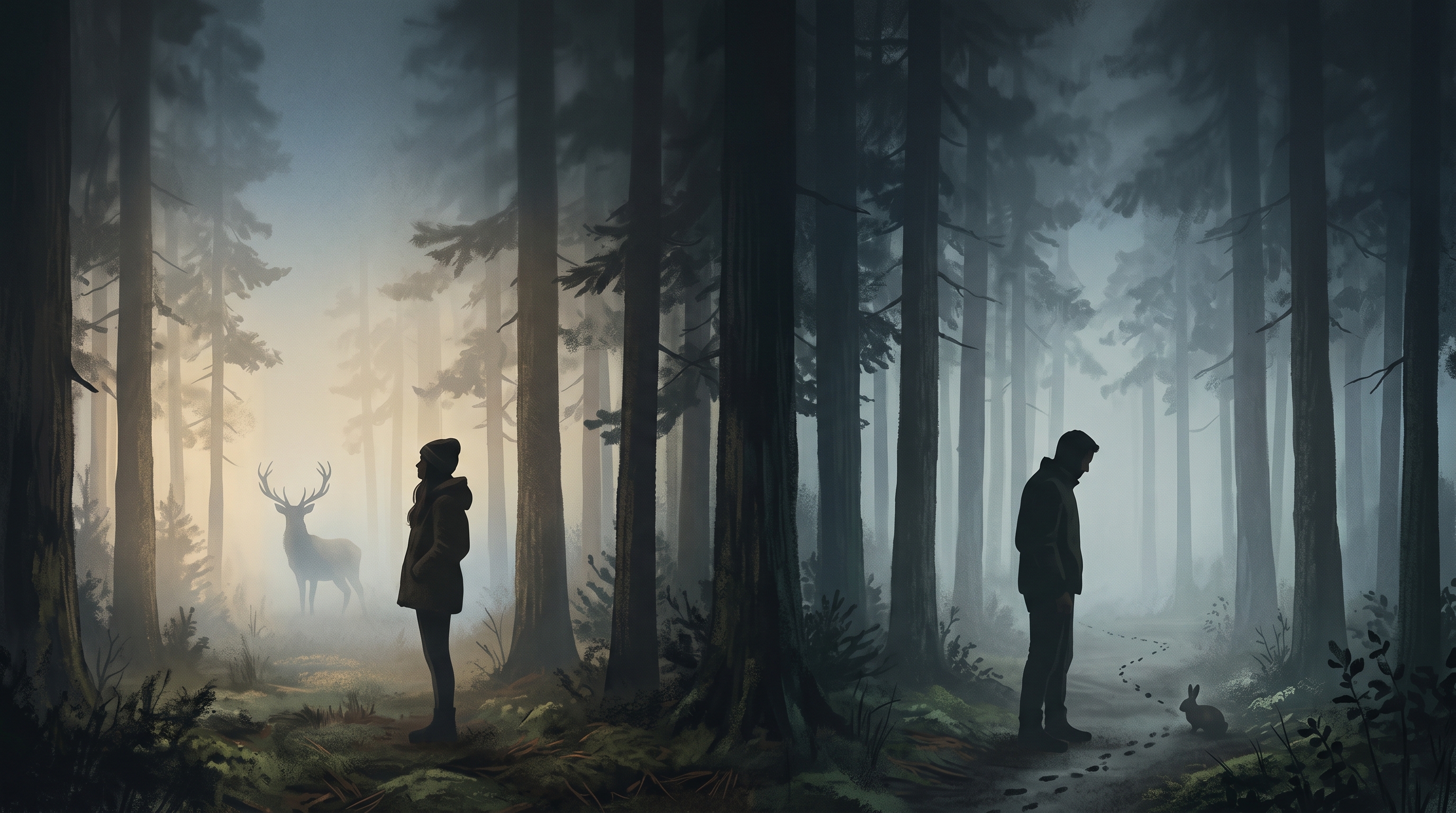
What is the force that pulls people in relationships toward the familiar stance, “I can only depend on myself”? A couple says they want to be together. And when they’re cooperating, they genuinely do, and they accomplish great things together with an aura of love and synergistic harmony. But when they get sufficiently scared, there’s a strong impulse to withdraw…to retreat…to “go it alone” — whether that refers to a particular goal they can’t agree on, or to their entire relationship — their goal of enjoying life together. Even when one partner is critical and blaming, and appears to be pursuing the other for reconnection, I usually find that there’s an augmenting script playing in the back of their mind… a growing doubt that it might not work — that they might wind up better off alone. Hence, the desperate bids for repair that often backfire. I think that game theory — in particular the game called “The Stag Hunt” — can shed some light on why there is so much fear of trust in couples’ relationships. You can catch a big stag with cooperation, and you can catch a rabbit alone. Either way, you eat. But what we really fear is starving — catching nothing. And that happens when cooperation goes sideways… when anti-synergy makes 1+1 equal zero or negative 10. When the fallback of operating like a single person is nowhere to be found. Your partner is off catching rabbits solo, and your stag, that you needed help catching, escapes. Or, you’re both trying to catch totally different stags, having mistaken them for the same animal. Or worst of all, the hunt never begins at all because endless arguments never produce a shared agreement for unifying your efforts. A lot of couples’ fights are really about what they’re aiming toward. What are they doing with money (their stored energy)? With free time together? With where to live? With parenting? With life? But unfortunately, the underlying issue of different goals gets buried under layers of two-way vilification and pathologization. Both sides can feel that the other suffers from varying forms of madness or badness, when in truth they simply have different preferences, which either can or cannot be sufficiently aligned such that they can enjoy life “well enough” together. And it’s the fear that alignment might not be possible that scares couples away from having the very discussions that would answer that question and resolve their uncertainty. In this video, I apply The Stag Hunt metaphor to couples, and offer several perspective shifts for when finding a common aim is challenging. I answer the question of when the best outcome is, in fact, to “hunt rabbits” (do their own thing) rather than cooperating toward something big. I explain why relationships that allow for the option of pursuing separate individual goals are ironically more likely to make genuine cooperation toward lofty, shared goals truly possible. I talk about why maturity entails letting go of the “survival belief” that, in families, there need to be winners and losers. And I offer some strategies for couples moving away from blame and shame, and looking honestly at the fundamental problem of unaligned individual life goals.

0 Comments

Defensive Judgment Vs Wise Discernment

“Don't judge me.” “You're being judgmental.” “This is a judgment-free zone.” We bristle at the word “judgment” and being judgmental, because we intuitively and reflexively sense real danger there. But in truth, every day we’re continuously making decisions and distinctions in order to live the lives that we want. X is better than Y. We choose this and not that. We let someone in, and keep another out. What really IS the difference between harmful/immoral/defensive judgment vs squarely looking at reality in order to decide what we include and what we exclude based on qualities that we determine are good for us or not? Just labeling it something else like "discernment" only goes so far. Separating the light and dark sides of judgment with semantics doesn't do the work of explaining what the difference actually is. The Tarot deck doesn’t shy away from the word “judgment”, including a card by that name which actually points at healthy discernment. And in our society we give someone the title of “judge” when we entrust them to make good and fair decisions. So what really is the difference between the light side and the shadow side of judgment? In this brief video, I relate this important distinction to the drama triangle, which I think is a complex of the dark side of interpersonal judgment.

0 Comments

The Drama Triangle: A Cocoon of Moral Certainty

It’s in our primal human nature to perceive conflict in terms of an archetypal meta-story with a victim, a villain, and a hero. This can make for an entertaining movie but, usually, seeing the real world in this way limits our growth, connection, and freedom by turning each other into dehumanizing caricatures and escalating conflict. Fast moral certainty comes with a high price tag. Psychologist Stephen Karpman named this pattern “the drama triangle”, and we’re so used to it that it feels normal and even inescapable. It shows up at every level of human relating, from the family to public discourse to international relations. The first step to rising above the drama triangle is to recognize it, which is the topic of this video. I examine why the drama triangle is so psychologically addictive, and five ways that it separates us from reality.

0 Comments

The Blind Spot That Keeps Conflict Alive

This basic question is, in my experience, central to almost all psychotherapy: “How much of this interpersonal problem is ‘my stuff’ and how much of it is ‘their stuff’ and how much is ‘our stuff’?” The same basic question from another angle: “how much of what I’m experiencing (perceiving, thinking, feeling, saying, doing) is because of the present reality in front of me, and how much of what I’m experiencing is because of my past conditioning?” We’re hardwired for continuous and responsive feedback exchange with each other, and at the same time we’re separate bodies and minds with personality tendencies that are unconnected to each another. It’s not simple to tease apart these two factors in our own behavior. And they’re even harder to disentangle in someone else’s behavior. Awareness of circular causality is the key to separating “me” from “you” from “us”. Without it, we’re shooting blind at the target of healthy relationships. In this video I argue that circular causality blindness was likely an evolutionarily adaptive perceptual distortion for both individuals and tribes, and that it also serves psychologically protective functions. We turn away from circular causality because doing so is in our DNA, and also because it makes us emotionally comfortable. I also claim that blindness to circular causality is gradually moving toward obsolescence and deprecation as a survival adaptation, and is shifting toward becoming more of an impairment psychologically, spiritually, and even existentially, despite the ease we feel from its simplicity. The costs of ignoring circular causality increasingly outweigh the benefits to the extent the world becomes more interconnected. Not perceiving circular causality explains a great deal of conflict, grief, isolation, and fear in the world today. Courageously opening our eyes to the circular causality between us is uncomfortable and challenging, but it’s also a bridge from suspicion to trust, from distance to intimacy, and from war to peace.

0 Comments

Circular Causality Blindness In Intimate Relationships

The more enduring and substantive the history between two people, the more personal their behavior toward each other will be. So where better to practice the subtle art of taking it personally than in marriages and intimate relationships? A couple’s mutual awareness of the circular causality between them can make the difference between a status quo stalemate for years and empathy that yields intimacy dividends for decades. Relationship problems can largely be explained by circular causality blindness, which leads to blame and resignation rather than accountability and effort. We tend to underestimate how much our own behavior shapes a partner’s behavior, which saves us from responsibility at the cost of empowerment. From the outside, it’s obvious that when both partners wait for the other to change before they change, nothing changes. Yet that’s often what happens. Comprehending the circular causality in a relationship dispels the absurdity of trying to improve a relationship by waiting passively or convincing a partner that they must change first. While not everything a partner does is caused by or related to what we do, it’s generally wise to assume that, because of our self-protective biases, we underestimate how much of our partner’s behavior is a response to our own, and so our influence in the relationship is probably greater than it feels.

0 Comments

The Myth Of Pure Evil And Circular Causality Blindness

When relationships are going well, we credit good intentions and enjoy the sweetness of harmony. But in conflict, we tell stories of “good vs evil” that erase shared responsibility. Between individuals and groups, there exists a human proclivity to make our side righteous and the other side wicked, because doing so is more comfortable than listening, empathizing, and compromising. Psychologist Roy Baumeister calls this “the myth of pure evil”. It’s the psychology behind polarization, tribalism, and conflict escalation. It allows harmful behavior to insidiously masquerade as virtue under the auspices of fighting evil. The myth of pure evil is not a denial of evil. It’s a denial that evil or blame lives exclusively on one side of any ongoing conflict. Awareness of the myth of pure evil is not an excuse for harm, but rather a prophylactic against unconsciously perpetuating it by failing to see the mix of darkness and light within all hearts and tribes, including our own.

0 Comments

Circle Eye Blind: Semi-Concealed Side Of Strife

Circular causality blindness" is what I call the psychological blind spot that causes us to selectively attribute others' behavior as a situational cause for our own, while simultaneously discounting how our actions act as a trigger for their behavior. Each partner or party within a system sees their own reactions as justified responses to the behavior of others. Two sides hold mirror-image half-truths, each convinced they’re merely reacting, rather than co-creating a mutually unsatisfying or destructive loop. This video explains how, due to various cognitive biases, we often give up on relationship problems, or make them worse with “solutions” that created the problems in the first place, because we only see one half of the “court” in the social game that we’re a part of, either voluntarily or involuntarily. It’s fairly easy to see circular causality from the vantage point of an outside observer of a system, for example observing someone else’s relationship. But when we are on the inside of that system as part of the circle, it’s much harder. We can make more conscious conclusions about what is likely in our blind spots if we’re aware of them which, to some extent, reduces our blindness. Seeing the full, reciprocal circle of influence helps us better comprehend the extent of our agency and the quality of our impact on personal relationships and, to some extent, the world.

0 Comments

Resources for art, writing, and other creative pursuits

Books The War of Art by Steven Pressfield https://www.amazon.com/War-Art-Steven-Pressfield-ebook/dp/B007A4SDCG?_encoding=UTF8&sr=8-1 The Creative Act by Rick Rubin https://www.amazon.com/Creative-Act-Way-Being-ebook/dp/B09Z7MH5C3?_encoding=UTF8&sr=8-1 Big Magic by Elizabeth Gilbert I wrote a summary of Big Magic here. https://www.amazon.com/Big-Magic-Creative-Living-Beyond-ebook/dp/B00S52M350?_encoding=UTF8&sr=8-1…

0 Comments